A Loss of Hope
The forbidden words no one ever wants to hear, “You have cancer.” They are life changing words- words that leave you paralyzed with fear, your mind immediately racing to the unimaginable. Your thoughts become dichotomous. Life and death. Good and bad.
I never imagined I would receive a breast cancer diagnosis at the age of 40 years old. I had always taken good care of my health. I exercised regularly and maintained a healthy diet. Nothing could have ever prepared me for such devastating news.
The diagnosis came shortly after a divorce. Just when I thought I was finally taking control of my life again, everything was turned upside down in an instant. I immediately went to a dark place and asked myself the question no one wants to face, “Am I going to die?” My hopes and dreams were shattered and any imminent plans quickly vanished. Any thoughts of a long and prosperous life felt fragile and distant. I had never felt more vulnerable, fearful and alone.
My life had changed forever.
Feeling a Lump
As a healthcare professional, I have always valued the importance of routine screenings. I knew that at 40 years old, I was due for my first mammogram. I had already scheduled it when, during a work shift, I felt a sharp, pulsating pain on the right side of my chest during a sudden movement. I instinctively placed my hand over the area of pain and noticed a lump in the upper part of my right breast. I was concerned, yet relieved to have both a gynecology appointment and mammogram scheduled on the same day of the following week. I knew my nurse practitioner would perform a breast exam during my annual visit, and felt reassured knowing the timing allowed for immediate evaluation.
At my gynecology visit the following week, I waited to see if she would notice the lump during my breast exam. She didn’t mention feeling anything concerning. After her exam, I mentioned to her the painful lump I had felt the week before. Even after further examination of my breast, she still could not feel it. She eventually had me sit up and point to the exact spot with my own finger. That is when she finally felt it, but believed it was likely just a cyst.
I mentioned that I had a mammogram scheduled shortly after her appointment. Fortunately, the timing worked in my favor. Because I had felt a lump, she would send a referral for a diagnostic ultrasound screening, ensuring it would be evaluated as soon as possible.
My First Mammogram
I arrived for my first mammogram appointment feeling nervous and unsure of what to expect. All I had ever heard from family and friends is that it was uncomfortable. The idea of having my breasts manipulated and compressed did not calm my nerves.
Adding to the stress, my appointment now required an additional diagnostic screening, which made the process feel more complicated. Had they received the referral yet? I knew all too well how slowly our healthcare system could move. While checking in and completing the intake questionnaire, one question stopped me: Have you felt a lump? For a moment, I considered not mentioning it—avoiding the hassle, the delays, the potential spiral of what-ifs. But deep down, I knew ignoring it wasn’t an option. Listening to my gut and advocating for myself felt uncomfortable, but it was also the safest and most important thing I could do.
After my mammogram, I sat in the waiting room for the ultrasound. That is when my fear came true- they hadn’t received the referral for the diagnostic ultrasound. The staff called the gynecology office twice, but no one responded. As the minutes stretched into nearly two hours, my anxiety grew. They asked if I wanted to leave and come back on a different day. Instead, I chose to wait, hoping they could reach my primary doctor. I knew it would be better to endure the wait than to return later and relive the uncertainty. Eventually, they received verbal authorization from my primary doctor, allowing me to move forward with the ultrasound.
After the ultrasound, the radiologist reviewed the images and told me it appeared to be a cyst, but with some irregularities. Because of the irregular borders, I was asked to return the following week for a biopsy. During the biopsy, I saw a different radiologist. He explained that the plan was to aspirate the lump first- if fluid appeared, it would confirm a cyst. But as soon as he inserted the needle, he said he couldn’t aspirate anything. He then added that it was an unusual place for a cyst. This struck my curiosity as the first radiologist had never mentioned that concern. Then he said, “I would be happy to biopsy this.”
In that moment, my heart sank.
After my visit, I left that day hoping for the best. I knew it would take three to five days to receive the results, but I couldn’t stop living while I waited. I was only three days away from my half marathon at Yosemite National Park. I had been training for this race for the last six months, and I wanted to stay positive, focused and prepared.
I completed my half marathon at Yosemite on May 10th, 2025, with a finish time of 3:27:58. I didn’t beat my goal time of 2:50:00, and I didn’t run the entire race. I still think about mile 11. That was my breaking point. I couldn’t run anymore and for the first time, I wanted to quit.
My legs burned and ached with every step. The pain was relentless—throbbing, shooting all the way up to my right hip. I was limping, exhausted, and mentally consumed by the discomfort. I had to keep reminding myself that I was almost done. I had come too far not to finish. I repeated the same words over and over in my mind: I can do hard things.
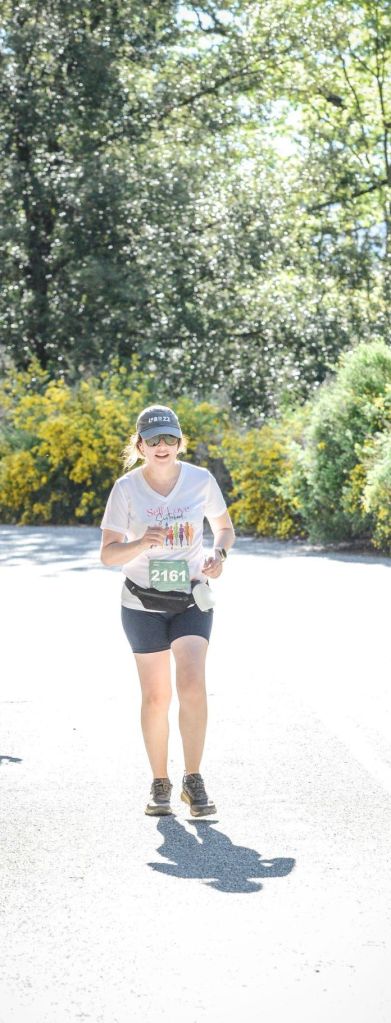
Despite crossing the finish line in intense physical pain, it was the best I had felt both physically and mentally. I was in the best shape of my life.
Completing that race felt like accomplishing something I once thought might be impossible. Even with months of preparation and training, there were so many unexpected challenges working against me. Hours of downhill running aggravated my IT band. The higher elevation made it hard to breathe. The heat left me dehydrated and drained. And yet, I finished.
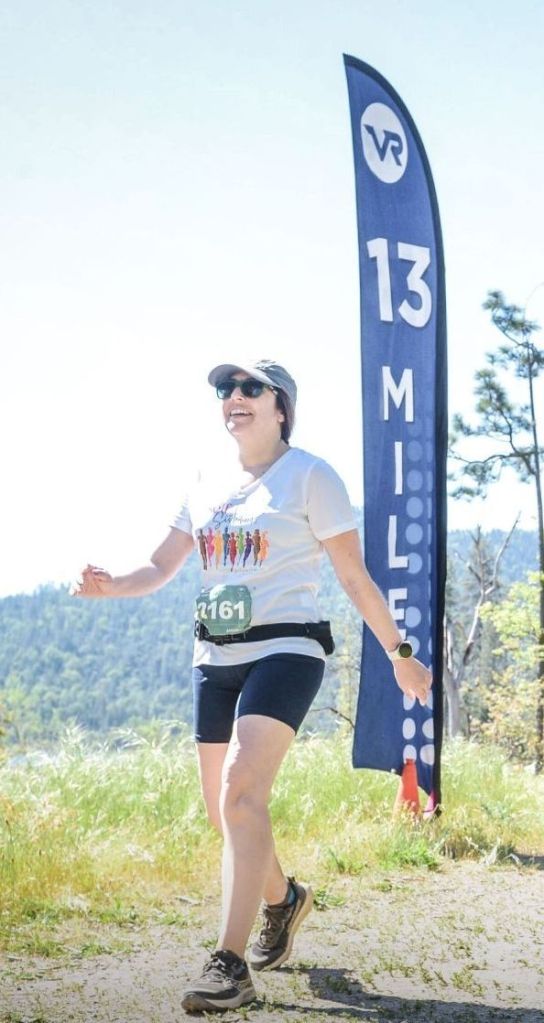
That day taught me how to find the gift in simply completing the race. It showed me that I could persevere through adversity—even when things didn’t go as planned.
Facing a Cancer Diagnosis: What’s Next?
I returned to work two days later, on May 12th. Within twenty minutes of starting my shift, my phone rang. It was the call for my biopsy results. I was asked if I had a moment and somewhere to sit. I could tell from the tone of the woman’s voice that something was wrong.
Her first words were, “I have some unfortunate news.” My heart started to race.
I was holding a pen and prepared to write everything down, but my hand was already shaking.
She continued. “You have an invasive ductal carcinoma that has broken through the duct. You also have a rare form of breast cancer called triple negative breast cancer.“
At that point, the tears began to flow. I struggled to focus, my body trembling as the weight of the moment set in. Just two days earlier, I had felt on top of the world, planning my next fitness and travel plans. Now, my world had collapsed.
“We don’t know what is feeding your tumor, but it is hormone negative and HER-2 negative. You have an aggressive cancer. There are three grades (1-3) and you have grade three, which means your cancer is growing quickly.”
In that moment, I was given three different treatment centers to choose from, yet I had no idea where I would receive the best care. Normally, I would have researched my own options and spoken with others before making such an important decision. I was told that I didn’t have to decide immediately, but I didn’t want to waste a single minute.
I had just been told I had an aggressive and rare form of cancer. I didn’t know how much time I had and how quickly it might spread. I chose the Banner Cancer Center, largely because it was what I knew and trusted. I was told my records would be sent there immediately and that someone would reach out soon. A referral from my primary care physician would also be requested.
At that point, I was apprehensive, wondering how long it would take to hear back. Hearing back from Banner the same day came as a relief. Because triple-negative breast cancer is aggressive, my case was expedited, and I was seen within two days of my diagnosis.
Almost immediately, I began to wonder how a diagnosis like this could happen at such a young age. In that moment, I turned the blame inward. As a healthcare professional, I should have pursued genetic testing earlier, knowing I was of Ashkenazi Jewish descent.
Later, genetic testing revealed that I had inherited a BRCA1 mutation. In a strange way, the result felt confirming—I had always felt it in my gut. For years, I had even told my younger sister that because I was so healthy, I had a quiet fear that cancer would come for me.
I felt an overwhelming sense of relief because the follow-through was unlike anything I had experienced in healthcare before. I knew then that I would be in good hands. I had no idea what lay ahead, but I understood in that moment that this would be my next journey, whether I wanted it or not—something I would have to face head-on.
I never asked, “Why me?” My therapist once told me that asking why only leads to theories. Instead, I focused on what was happening.
Is the race over?
I often think about the timing of events in our lives—how some moments feel intentional, even when they are unexpected. My half-marathon training coincided with my cancer diagnosis. I don’t believe that was a coincidence. It felt synchronistic, as though the miles I was logging were quietly preparing me for a much harder race ahead.
At the time, I didn’t realize it, but my training taught me how to endure discomfort, stay present when things felt overwhelming, and to keep moving forward one step at a time. Those lessons became essential as I faced my cancer journey.
Reflecting back, I know now that the heart of the race wasn’t at the finish line. It lived in the months leading up to it—in the discipline, the perseverance, and the quiet determination to show up each day. While crossing the finish line mattered, the deeper meaning was in the journey itself. During long, arduous miles, I ran through some of the most beautiful parts of the Arizona desert—Sabino Canyon, Catalina State Park and Tumamoc Hill. Even in physical exhaustion, I was surrounded by beauty. I strengthened connections with friends and family, stayed present, and learned to recognize joy even in difficult moments. I found the gift in each day.
My breast cancer journey was a race I never wanted to start. It began with four major procedures: an egg retrieval, a salpingo-oophorectomy, a double mastectomy with breast reconstruction, and surgery to address a wound complication. Then came chemotherapy—the most challenging leg of the race. It took me on an emotional roller coaster I could never have imagined. There were moments of physical pain, emotional exhaustion, and fear. During those times, I repeated the same phrase I had relied on during my half marathon: I can do hard things.
I learned to celebrate small victories—the days I felt well enough to take a walk, enjoy my favorite foods, or simply feel like myself again. I leaned deeply into the love and support of friends and family. Through it all, my life took on a new sense of purpose and meaning. I am a cancer survivor, and that will stay with me for the rest of my life. This journey continues. Treatment may end, but the race does not.
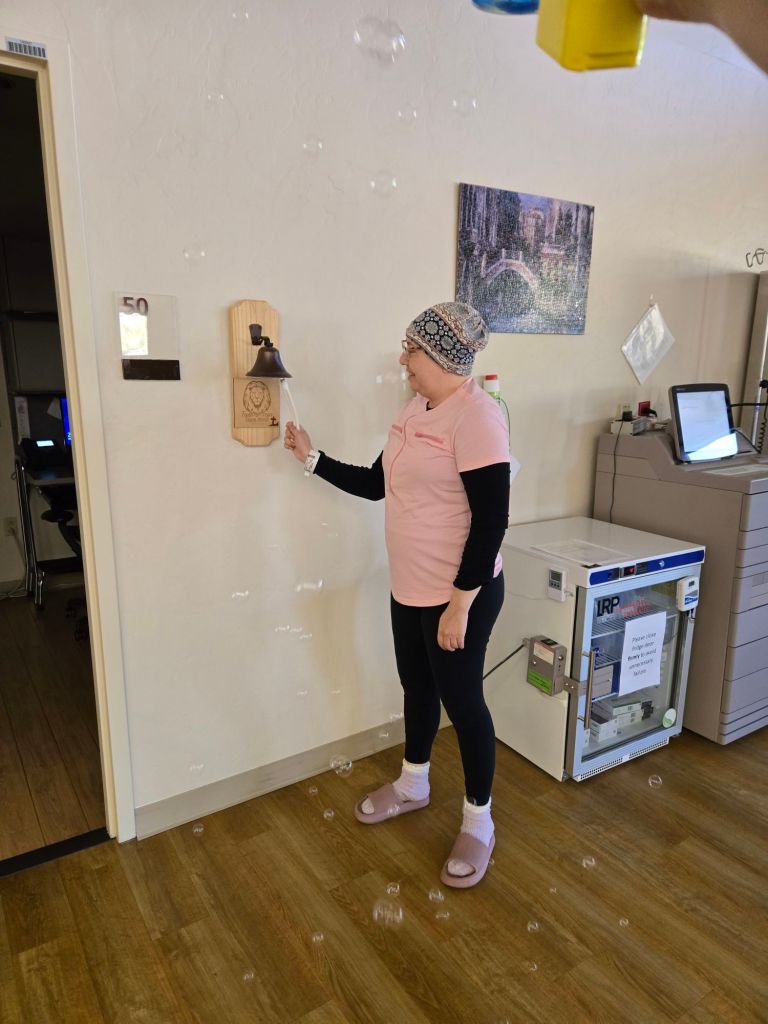
I’ve come to realize that the race is never truly over—and that’s okay. The work of healing, growing, and living fully is ongoing. What matters most is how we choose to live each day. One may cross a finish line, but the journey doesn’t stop there. Our physical and emotional lives continue to evolve, reminding us that growth is a lifelong process.
My body carried me through a half marathon while I was living with breast cancer. For that, I don’t just feel proud—I feel deeply grateful. And yes, I think that deserves a gold medal!
 My Post-Divorce Glow